

Part VI: Bonus Material
1. Modern Engineering Systems
New residential buildings in Switzerland are increasingly defined by centralized, energy-efficient engineering systems rather than individual boilers or ad-hoc solutions. For buyers, understanding these systems matters not only for comfort and running costs, but also for long-term maintenance, resale value, and regulatory compliance.
This chapter provides a practical overview of the main technical systems you will encounter in modern new-build apartments and what they mean for you as an owner.
Heating and Cooling
Heat Pumps
As of 2025, heat pumps are the standard heating solution in most new Swiss residential developments.
All heat pumps work on the same principle: they extract low-temperature heat from the environment and raise it to a usable temperature for space heating and hot water. The key difference lies in where the heat comes from.
Common types
-
Air–water heat pumps (same principle as normal AC)
- Extract heat from outside air
- Lower installation cost and simpler permitting
- Slightly less efficient during very cold winter days
-
Ground-source (geothermal) heat pumps
- Use boreholes or ground loops in the ground
- Higher upfront cost
- Very stable efficiency year-round, independent of air temperature
-
Hybrid systems
- Combine a heat pump with district heating or a backup system
- Often used where district heating is available but seasonal flexibility is desired
- District heating itself is usually reliable and competitively priced, but hybrids add redundancy and peak-load security
Heat pumps typically supply:
- Underfloor heating
- Domestic hot water
- As of 2025, also passive cooling in summer
Low flow temperature means the heating system circulates water at ~30–35 °C instead of 60–70 °C as in old radiator systems. Heat pumps are far more efficient at these lower temperatures, which is why radiators are rare and underfloor heating is standard in new buildings.
Heating systems
In modern projects, underfloor heating often means more than pipes spread evenly across the slab. Designers frequently add extra loops in perimeter zones, along window fronts, or directly in the concrete ceilings.
Typical combinations include:
- Floor-heating loops at window fronts and outer edge zones
- TABS / thermally activated concrete slabs or other ceiling-embedded loops
These systems also run at low temperatures, which makes them a good match for geothermal and heat-pump installations.
In winter, loops along large window areas help keep the zone near the windows warmer. This reduces the cold feeling you often get beside them and helps limit downdraught from window fronts.
TABS / ceiling activation uses the same principle across a larger surface: the concrete slab itself becomes a thermally active mass. This delivers very even temperatures, but it reacts more slowly than point-source heating systems.
Cooling systems
Active air conditioning is uncommon in Swiss residential buildings. Instead, comfort in summer is achieved through a combination of passive measures:
- Passive cooling (free cooling) using ground loops
- Night ventilation via mechanical systems
- Solar shading (blinds, shutters)
- Thermal mass of concrete structures
In buildings with geothermal systems, free cooling works by circulating naturally cool ground temperatures through the low-temperature floor circuits or thermally activated ceiling slabs without running a compressor. This provides gentle cooling with minimal energy use.
Ice Storage Systems
Ice-storage systems are rare but technically advanced solutions found in some flagship developments.
How they work
- A large underground water tank is installed
- Heat pump extracts heat from the water
- As the water freezes, it releases additional energy (latent heat)
- The tank is re-heated using:
- Solar thermal energy
- PVT panels
- Ambient air
This allows the system to store energy seasonally and operate efficiently year-round.
Why developers use them
Advantages
- High overall efficiency, measured via Seasonal Performance Factor (SPF)
- No deep geothermal drilling required
- Works well with renewable energy sources
Challenges
- Complex control logic and planning
- Higher upfront cost due to tank construction and integration
- Requires experienced designers and operators
Ice-storage systems can perform extremely well — but only if correctly sized and professionally managed.
Hot-Water
Centralized Hot-Water Production
In modern apartment buildings, hot water is almost always produced centrally and distributed to individual units.
Typical setups
-
Heat-pump hot-water tanks
Large insulated tanks heated by the central heat pump.
→ Efficient, but recovery time matters if many apartments draw hot water simultaneously. -
Combined heating + hot-water systems
One integrated system serves both underfloor heating and hot water.
→ Efficient design, but requires good dimensioning. -
Solar thermal support
Roof-mounted collectors assist hot-water production.
→ Less common than PV, but still used in some projects.
What buyers should know
-
Circulation systems mean hot water arrives quickly at the tap
→ Comfort benefit, but slightly higher energy losses (already accounted for in modern designs) -
Individual metering means you pay only for your consumption
→ Important in mixed-use or investor-heavy buildings -
Legionella protection is handled automatically
→ Systems periodically heat water to higher temperatures
→ This is a technical compliance issue, not something buyers must manage
Water Softening and Treatment
A water softener reduces water hardness and limescale deposits. Where the supply is hard, this can mean less cleaning of taps and shower screens and less descaling of hot-water equipment. Hard water itself is not a sign of poor drinking-water quality.[1]
Water hardness varies across Switzerland, including within the Zürich region. Zürich city reports 14–19 °fH (French degrees of hardness), spanning soft to moderately hard water on the Swiss scale; nearby Kloten reports 27–33 °fH. Ask the local water supplier for the current value at the property’s address before deciding how useful a softener would be.[2]
An ion-exchange softener replaces calcium and magnesium with sodium. Its resin is regenerated with salt, so the system needs regular salt refilling and servicing. Include these running costs when comparing projects.[3]
Filters, UV disinfection and reverse osmosis serve different purposes. Ask what the specified equipment treats; do not assume it removes every contaminant.[4]
Before buying, ask:
- Which cold- and hot-water outlets receive treated water? Is the kitchen drinking-water tap bypassed?
- What treatment method and target hardness after treatment (residual hardness) are specified?
- Who refills salt or replaces filters, arranges servicing and pays the running costs?
If the building specification does not mention water treatment, ask the developer whether an installation is included in the purchase price or would cost extra.
Renewable Energy
Photovoltaics (PV)
Solar panels are now standard in new residential buildings.
Electricity generated is typically used for:
- Common areas (lifts, lighting)
- Heat pumps
- Partial apartment consumption
Self-consumption models (ZEV)
A self-consumption community (ZEV) allows multiple apartments to share locally produced solar electricity.
What this means for buyers:
- You consume solar power before buying from the grid
- Lower electricity costs
- Transparent allocation via smart meters
PVT and Advanced Systems
PVT panels combine:
- Electricity generation (PV)
- Heat extraction (thermal)
The thermal energy is used to support heat pumps, improving overall efficiency—especially in winter.
Other emerging concepts:
- Seasonal storage (thermal energy stored over months)
- Battery systems for peak-load smoothing (not full off-grid operation)
- Grid-friendly load management
These systems aim to reduce grid stress and operating costs, rather than provide full energy independence.
Ventilation
Mechanical Ventilation with Heat Recovery
Modern apartments are airtight by design. To maintain air quality, they use mechanical ventilation with heat recovery.
Heat recovery means:
- Warm exhaust air transfers its heat to incoming fresh air
- Fresh air enters already pre-warmed
- Energy losses are minimized (often 80–90% recovery)
Typical system characteristics
- Fresh air supplied to living rooms and bedrooms
- Stale air extracted from kitchens and bathrooms
- Filters remove pollen and fine dust
System types
-
Centralized systems
- One system for the entire building
- Lower maintenance for individual owners
- Less individual control
-
Apartment-level units
- Individual control per apartment
- Easier fault isolation
- Slightly higher maintenance responsibility
Some projects supply fresh air only to living rooms and bedrooms—this is acceptable if correctly designed.
Poorly designed systems can cause odour transfer between apartments. Buyers should ask whether the system uses separate air paths and proper pressure balancing.
Ventilation Matters
Modern, highly insulated buildings are nearly airtight. Without controlled ventilation, this can lead to:
- Elevated CO₂ levels
- Moisture buildup
- Mold growth
- Persistent odours
In this case, opening windows alone is not sufficient for air quality control. Ventilation systems are a core part of the building concept, not an optional extra.
Facades and Building Envelope
The façade is not only about appearance. In a new-build apartment, the exterior wall system directly affects:
- Moisture safety
- Summer comfort
- Acoustic performance
- Maintenance costs
- How the building ages visually over 20–50 years
In Swiss apartment constructions, the most common standard façade is the external thermal insulation composite system (ETICS, often called Kompaktfassade): mineral wool fixed to the exterior wall and finished with reinforced plaster/render. Ventilated façades exist as well, but they are usually the more premium and less common option.
ETICS (Kompaktfassade)
Typical build-up:
- Structural wall in concrete or masonry
- Mineral wool insulation fixed directly to the wall
- Reinforcing layer with mesh
- Finish coat in plaster/render
Why it is so common:
-
Cost-efficient and standardized
- Cheaper than ventilated cladding.
- Contractors and suppliers use it routinely across Switzerland.
-
Good thermal performance
- Mineral wool provides strong insulation and also helps with fire performance and acoustics.
-
Slim wall build-up
- No ventilated cavity or cladding substructure is needed.
-
Clean visual appearance
- Easy to achieve a uniform rendered look across a whole development.
What buyers should watch:
-
More sensitive outer surface
- Render can crack, chip, stain, or develop algae over time.
-
Less forgiving if water gets behind the finish
- Drying is slower than in a ventilated façade.
- Window reveals, balcony connections, and penetrations must be detailed carefully.
-
More visible maintenance cycle
- Cleaning, repainting, and local render repairs may be needed sooner than with panel cladding.
-
Impact damage
- Ground-floor zones and balcony-adjacent walls can be more vulnerable to knocks and dents.
A standard Kompaktfassade is not “cheap construction” by default. It is simply the normal Swiss baseline solution for many apartment projects and can perform very well when the detailing and workmanship are good.
Masonry Cavity Wall / Double-Shell Wall
Some buildings use a double-shell wall with an outer masonry leaf and cavity. This is more common in certain house types or region-specific construction traditions than in standard developer apartment blocks.
Typical strengths:
- Very robust outer layer
- Good acoustic mass
- Long service life
Typical weaknesses:
- Thick wall build-up
- Higher material and labor cost
- Less flexibility for modern panel-based façade design
Prefabricated Concrete or Sandwich Panels
Larger projects sometimes use prefabricated façade elements with insulation integrated in the panel.
Typical strengths:
- Fast installation
- Good factory quality control
- Durable exterior surface
Typical weaknesses:
- Joints become critical
- Repairs and later modifications become more difficult
- Appearance feels more repetitive unless carefully designed
Timber-Hybrid and Natural-Material Construction
Some premium projects now advertise timber-hybrid construction or combinations of wood with natural materials such as clay blocks, clay plaster, hemp-lime, or lime-based insulation. In a modern apartment building, timber is usually part of an engineered wall, floor, roof, or façade system, often combined with concrete, masonry, or mineral layers where structure, fire protection, sound insulation, or waterproofing require it.
Typical combinations include:
- Concrete or masonry for basements, retaining walls, lift cores, stairwells, underground garages, and earth-contacting elements
- Timber or engineered timber elements for upper-floor walls, ceilings, roof structures, or prefabricated panels
- Clay blocks or clay plaster for thermal mass, humidity buffering, and indoor comfort
- Hemp-lime or similar bio-based materials as insulation, wall infill, or climate-regulating layers
- A ventilated façade, render system, or other weather-protective outer layers to keep the structure dry
These materials can be attractive because they reduce embodied carbon, support a more pleasant indoor climate, and often fit well with low-energy heating and cooling systems. But they also require more precise documentation than a standard concrete or masonry project. The key question is not simply “Does the building contain wood?” but:
- Which parts are load-bearing?
- Which parts are exposed to weather, and which are protected inside the envelope?
- How does the wall or roof dry if moisture enters?
- Which fire, acoustic, and moisture calculations apply to the actual build-up?
- What maintenance will the owners’ association be responsible for after handover?
For timber-hybrid or natural-material projects, ask for the full Baubeschrieb, façade and roof sections, fire-protection concept, acoustic report, moisture-protection concept, and maintenance instructions before signing. Natural materials can perform very well, but marketing words like sustainable, healthy, or hybrid are not a substitute for a documented construction system.
Ventilated Facade
A ventilated façade (hinterlüftete Fassade, often called a rainscreen façade) has a physical air cavity between the insulation and the visible outer cladding.
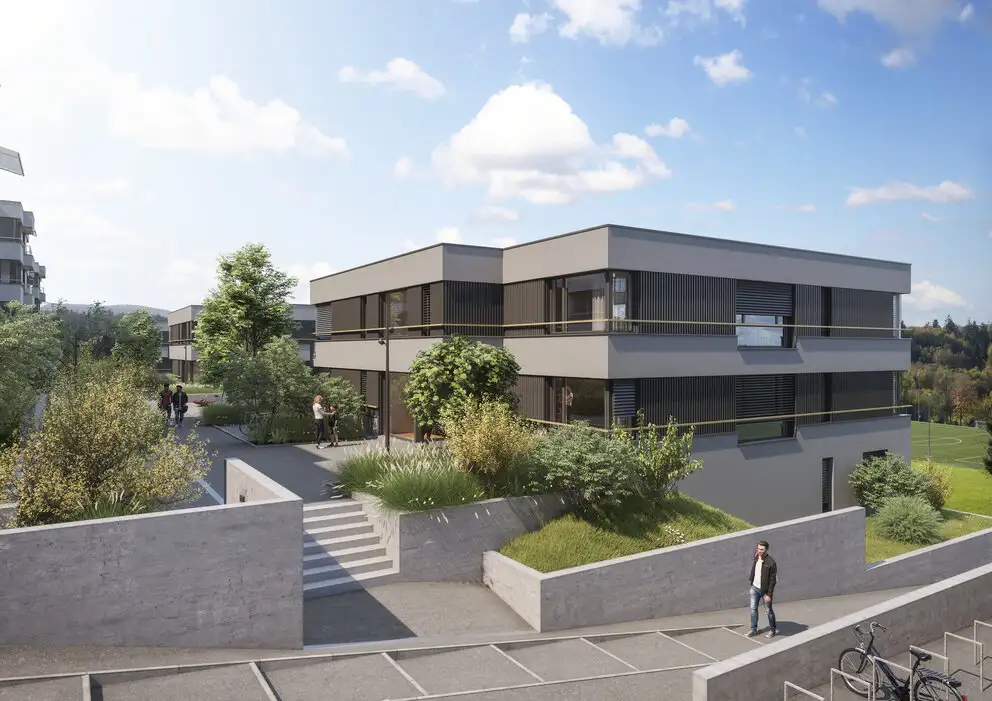
Typical build-up:
- Structural wall in concrete or masonry
- Insulation fixed to the wall
- Ventilated air gap, usually around 20-40 mm
- Outer cladding in fiber cement, metal, ceramic, stone, HPL, or timber
The cavity is open at the bottom and top so air can circulate. This allows the system to dry more easily if wind-driven rain or condensation reaches the back of the cladding.
Advantages
-
Better moisture management
- The cavity helps remove trapped humidity and incidental water.
- This makes the system more forgiving than Kompaktfassade / ETICS.
-
Better summer behavior
- Sun heats the outer cladding first.
- Part of that heat is carried away by rising air in the cavity before it reaches the insulated wall.
-
Higher durability
- Cladding panels expand and contract more freely than rendered surfaces.
- This reduces the risk of visible hairline cracking.
-
Lower maintenance over time
- Individual panels can often be replaced locally.
- The finish usually does not need repainting as often as rendered façades.
-
Often better acoustics
- The decoupled outer skin and mineral insulation can improve sound reduction, especially near busy roads.
The downside
-
Higher upfront cost
- The cladding needs a substructure in aluminum, galvanized steel, or timber.
- Installation is more complex than a standard rendered façade.
-
More detailing risk
- Fire barriers, cavity closures, corners, and window reveals must be designed and executed correctly.
- A badly detailed ventilated façade can still leak or whistle in strong wind.
A ventilated façade is often more robust and more durable than a standard Kompaktfassade, but it is not automatically “better” in every project. The value of the upgrade depends on budget, exposure to weather, architectural goals, and execution quality.
Comparison at a Glance
| Aspect | Kompaktfassade / ETICS | Ventilated façade |
|---|---|---|
| Upfront cost | Lower | Higher |
| Moisture robustness | Good if perfectly sealed, but less forgiving | Better drying and drainage reserve |
| Summer heat handling | Relies mainly on insulation and shading | Cavity helps vent away part of solar heat |
| Crack resistance | Render can show hairline cracks over time | Cladding usually handles movement better |
| Maintenance | Render cleaning and repainting may be needed sooner | Usually lower, with local panel replacement possible |
| Repairability | Local repairs can remain visible | Damaged panels can often be swapped individually |
| Typical market position | Standard | More premium |
Engineering systems directly influence:
- Energy costs
- Summer comfort
- Indoor air quality
- Maintenance effort
- Long-term value
You don’t need to master the technical details—but you should understand which systems are used and why.
In the following chapters, we explain how these systems relate to Minergie, SNBS, energy certificates, and what owners are responsible for once the building is in operation.
Prefer the full 2026 edition?
Get the complete PDF and EPUB edition published by Huusli, with the full contract, handover, defect, and warranty chapters in one place.